
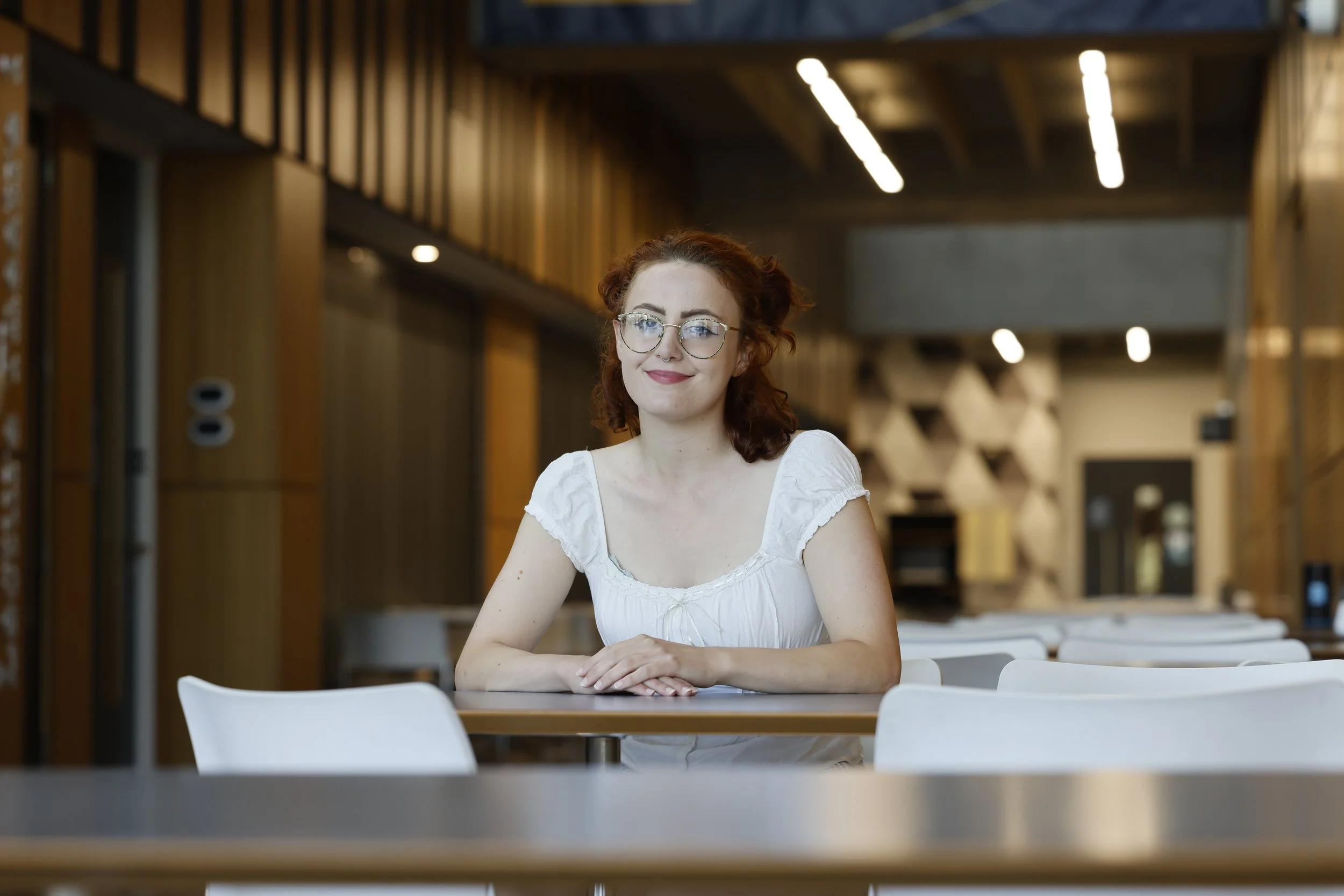
Portraits of Student Award Winners
I recently photographed a series of student award winners for the Health and Social Care faculty at Manchester Metropolitan University. The brief was to make portraits of the students around the university campus, giving each person a photograph that felt individual while still working as part of a coherent set.
With this kind of portrait photography, I often find that the first part of the job is simply walking around and looking. Universities have plenty of potential locations, but finding the ones that actually work can take some time. I was looking for clean backgrounds, good light and spaces where the surroundings wouldn't compete too much with the person.
Finding the light
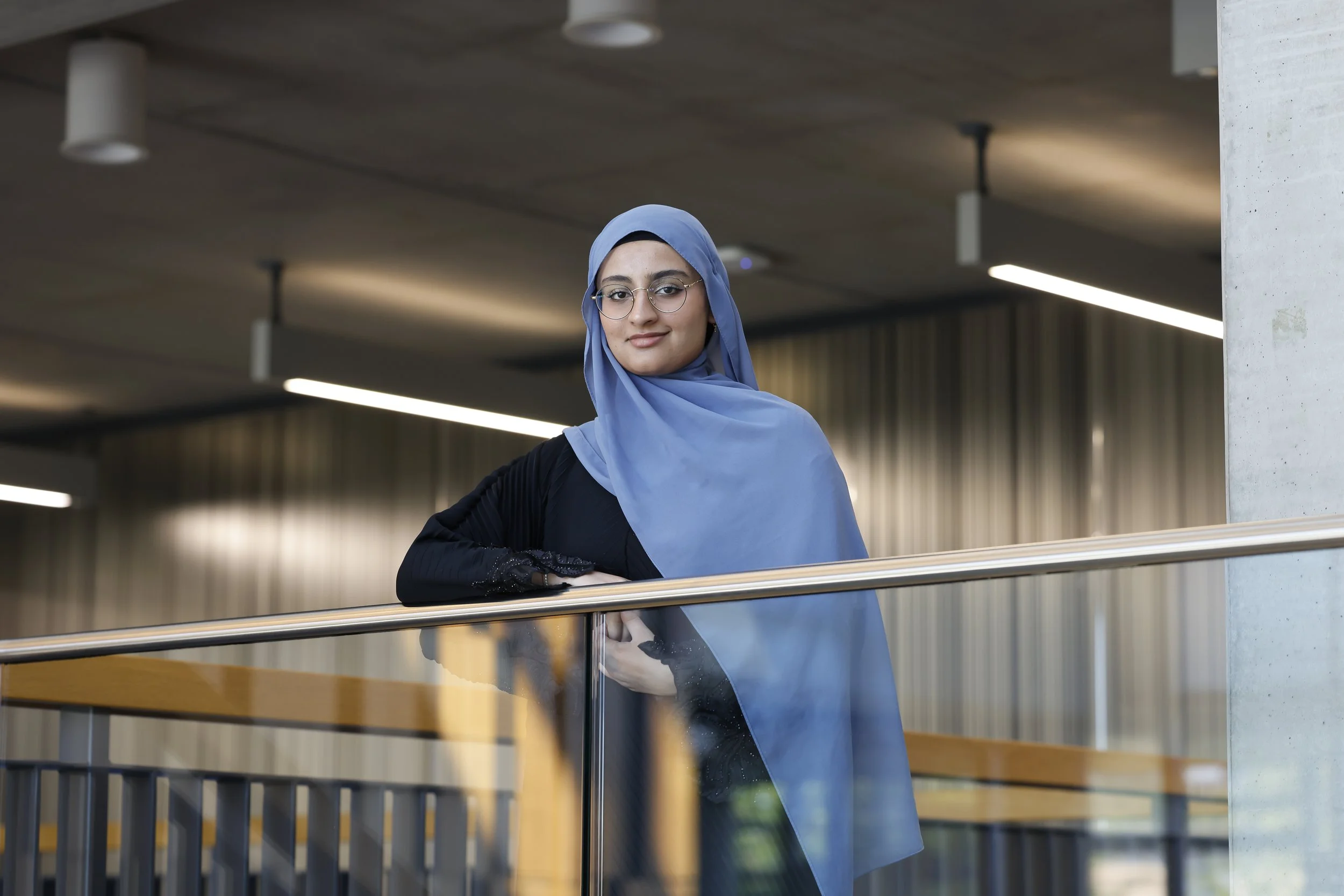
For this shoot I worked entirely with natural light. There was no additional lighting, so finding the right light became a big part of making the photographs.
Around the campus I was looking for large windows and areas where daylight was falling evenly across a wall or into a room. Big, soft sources of daylight can be particularly useful for portraits because they give a very flattering light without requiring much equipment.
I was also looking for places where the light created something a little less predictable. In a few locations, hard sunlight was falling across white surfaces and creating quite strong shadows. That's not necessarily the kind of light I would normally look for in a portrait, but in this case the shadows added something to the photographs. They gave the images a bit more structure and made some of the portraits much more dynamic.

Clean backgrounds and simple compositions
The other thing I was looking for was simplicity. University campuses can be visually quite busy, with signage, furniture, equipment and people moving around in the background. Sometimes those things are useful because they tell you something about where the photograph was taken, but they can also make a portrait feel cluttered.
I was trying to find backgrounds that gave the portraits some space. A plain wall, a large window or a simple architectural detail can be enough. Once the background is working, you can concentrate much more on the person.
This is something I think about a lot when photographing on location. The background doesn't have to be completely empty, but it needs to support the portrait rather than compete with it. Moving a few metres in one direction or another can completely change the photograph.
Making people comfortable
Most people aren't used to having their portrait taken professionally, and student award winners are no exception. Being recognised for their work or achievements doesn't necessarily mean that someone is comfortable standing in front of a camera.
A large part of my job is therefore making the process feel straightforward. I talk to people, explain what I'm looking for and make small adjustments as we go. Rather than expecting someone to know how to pose, I'll give them some direction and then look for the moments when they start to relax.
I think that shows in the photographs. The aim isn't to make everyone look as though they're doing exactly the same thing. It's to give people enough direction to make a good picture while allowing some of their own personality to come through.

Working with natural light
Because the photographs were made entirely using daylight, the light changed quite a lot as we moved around the campus. That meant responding to each location rather than trying to force the same lighting setup onto every portrait.
Some of the photographs were made indoors, close to large windows where the light was soft and even. Others worked because of the harder daylight and the shadows it created. We also went outside for some of the portraits, where the surroundings gave us a different relationship between the person and the university campus.
I enjoy this way of working because it keeps the process fairly fluid. I'm not carrying a lighting setup from one location to another, so I can move quickly and concentrate on finding the next good piece of light.
Looking for something different
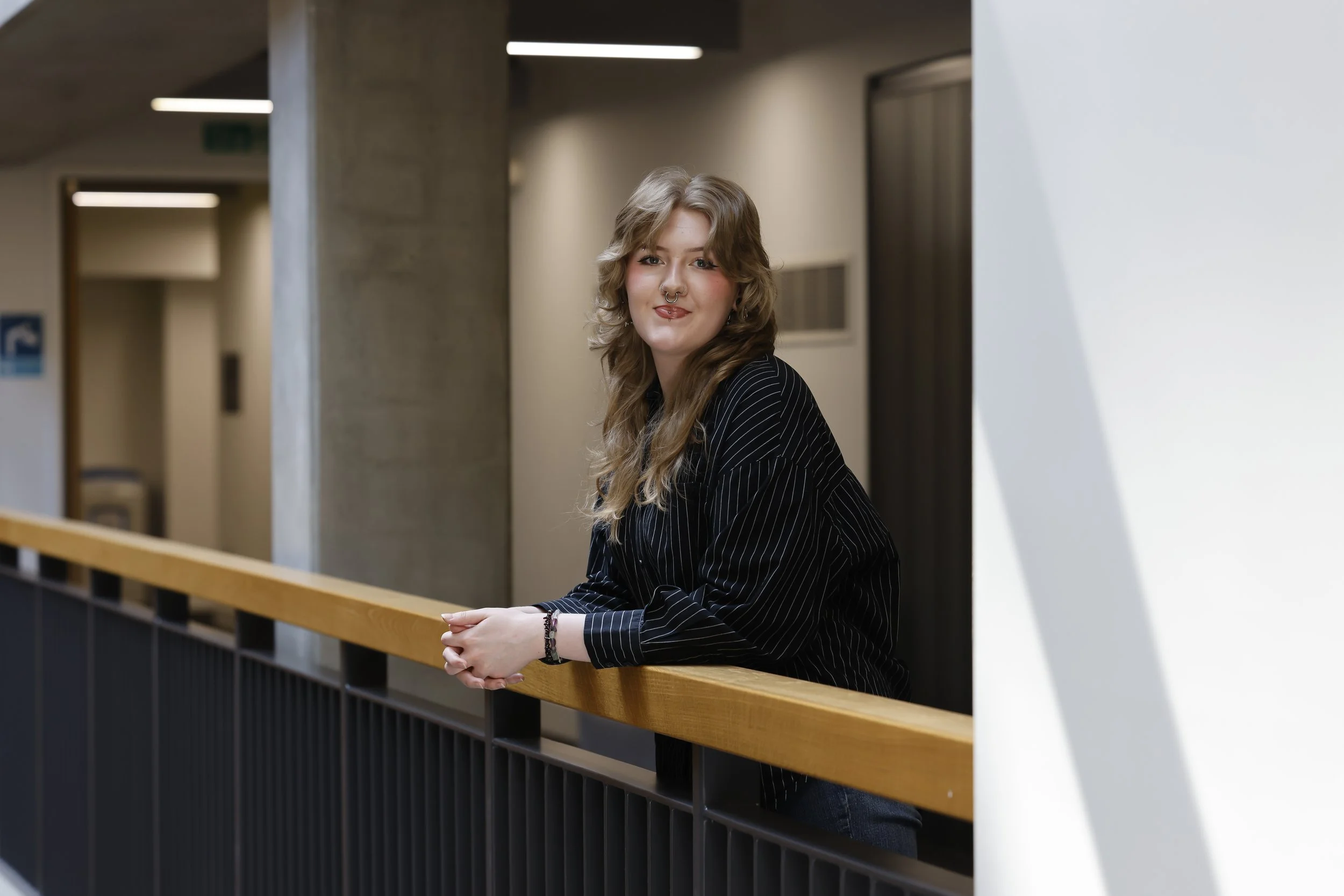
The harder light was probably the most interesting part of this particular shoot. I'm often drawn to soft, clean light for portraits, but when I found sunlight creating strong shadows across a white surface, it seemed worth using rather than avoiding it.
The shadows gave the photographs a stronger graphic quality. They created shapes within the frame and made the backgrounds feel much more active, while still keeping the overall compositions simple.
It's a useful reminder that there isn't necessarily one type of light that works for portrait photography. Soft window light might be perfect for one person and one setting, while strong sunlight can give another portrait much more character.

Photographing a series
When you're photographing a number of people for the same organisation, there is another challenge: the photographs need to feel connected without becoming repetitive.
I was looking for enough consistency that the images would work together as a series, particularly in terms of the quality of the light and the simplicity of the compositions, while allowing each location and each person to be slightly different.
Moving around the campus helped with that. Instead of putting every student against the same background, I could respond to what was available and find something that suited each portrait.

Portrait photography on location
This kind of assignment is a good example of why I enjoy environmental portrait photography. The surroundings become part of the process, but they don't necessarily have to dominate the final photograph.
A lot of the work happens before the camera comes out. I'm looking at the quality of the light, considering where someone might stand, checking what is behind them and thinking about how all those elements will work together. Then there is the human side of the job, getting someone comfortable enough that the photograph feels natural.
For these Health and Social Care student award winners at Manchester Metropolitan University, the combination of natural light, simple backgrounds and different locations around the campus gave me plenty to work with. The result is a varied set of portraits that reflect the individual students while still belonging to the same series.