
Sue Steer for the Royal Institute of Chartered Surveyors

I was commissioned by the London-based creative agency Sunday to photograph Sue Steer for an editorial feature in Modus magazine, published by the Royal Institution of Chartered Surveyors. The brief was simple on paper: travel to Shropshire, meet Sue at her home, and create a set of environmental portraits that reflected both her professional identity as a rural surveyor and her life within the landscape she works in.
In reality, the assignment became something far more memorable—a journey into one of the more remote corners of the English countryside, where navigation, patience, and persistence became as important as the photography itself.

Commissioned Editorial Photography for the Royal Institution of Chartered Surveyors
The assignment was produced for Modus, the flagship publication of the Royal Institution of Chartered Surveyors, and commissioned through the creative agency Sunday, a London-based studio specialising in editorial and commercial storytelling.
From the outset, the brief called for a naturalistic portrait approach. The intention was to document Sue Steer not in an abstract professional context, but within the lived reality of her environment—her home, her land, and the rural context that defines her work as a surveyor.
This type of editorial photography relies heavily on observation rather than staging, and Shropshire offered a landscape that naturally supported that approach.

Navigating Deep into the Shropshire Hills for the Assignment
Getting to the location was the first challenge of the day. The shoot took place deep within the Shropshire Hills, an area known for its rolling terrain, narrow lanes, and occasional resistance to modern navigation systems.
Sue’s husband Martin had done everything possible to guide me in: detailed WhatsApp directions, pinned locations, and even a What3Words reference. Despite all of this, the signal, the signage, and the winding rural roads made the final approach unexpectedly complex.
At one point, after circling the same lanes repeatedly and passing a bemused local farmer several times, it became clear I was close—but not quite there.

The Final Approach to a Hidden 15th-Century Cottage
Eventually, Martin drove out to meet me and guide me in directly, which transformed confusion into relief almost instantly. The destination turned out to be entirely worth the effort.
The house itself was a 15th-century thatched cottage, accompanied by a listed timber barn. It sat quietly within the landscape, surrounded by orchards and mature trees, almost absorbed into its surroundings. It felt less like a property and more like something grown from the land itself.
Visually, it had the character of a storybook setting—timber lines, uneven textures, and soft weathered tones that immediately suggested a strong visual narrative for portrait photography.

First Impressions of Sue Steer’s Rural Working Environment
Meeting Sue Steer in this environment immediately shaped the tone of the shoot. As a rural surveyor, her professional life is closely connected to land, property boundaries, and agricultural landscapes, and her home reflected that relationship in a very natural way.
There was no separation between domestic space and working landscape. Instead, everything existed in continuity: the house, the barn, the orchards, and the surrounding fields forming a single coherent environment.
From a photographic perspective, this allowed the portrait work to evolve organically rather than being imposed onto a location.

Environmental Portrait Photography in a Historic Shropshire Setting
The shoot itself unfolded over several hours, moving between different parts of the property. We worked inside the cottage, around the timber barn, and gradually out into the surrounding orchard spaces.
The goal was to allow the portraits to emerge naturally from interaction rather than direction. This is often where editorial photography becomes most effective—when the subject is comfortable enough for real expression to appear without pressure.
The textures of the 15th-century architecture, combined with soft natural light, provided a strong visual foundation for the final images.

Working with Natural Light in a Thatched Cottage Interior
Inside the cottage, the lighting conditions were challenging but rewarding. Thick walls and small window openings created strong contrasts between light and shadow, requiring careful exposure control and patience with changing light levels.
Rather than trying to overpower the space, I worked with it—allowing directional light to shape the subject and using the environment as a framing device. These conditions often produce some of the most atmospheric editorial portraits, particularly when working in older buildings where light behaves unpredictably.
The interior spaces reinforced the sense of history embedded in the property, which added depth to the portrait narrative.

Photographing Around the Barn and Orchard Landscape
Moving outside, the timber barn and surrounding orchards offered a completely different visual language. The structure of the barn provided strong compositional geometry, while the orchard introduced softer, more organic forms.
This contrast between built and natural environment became central to the photographic approach. It allowed the images to reflect not just Sue as a subject, but her relationship to the rural land she works within professionally.
These transitions between environments helped build a layered editorial story rather than a single-location portrait set.
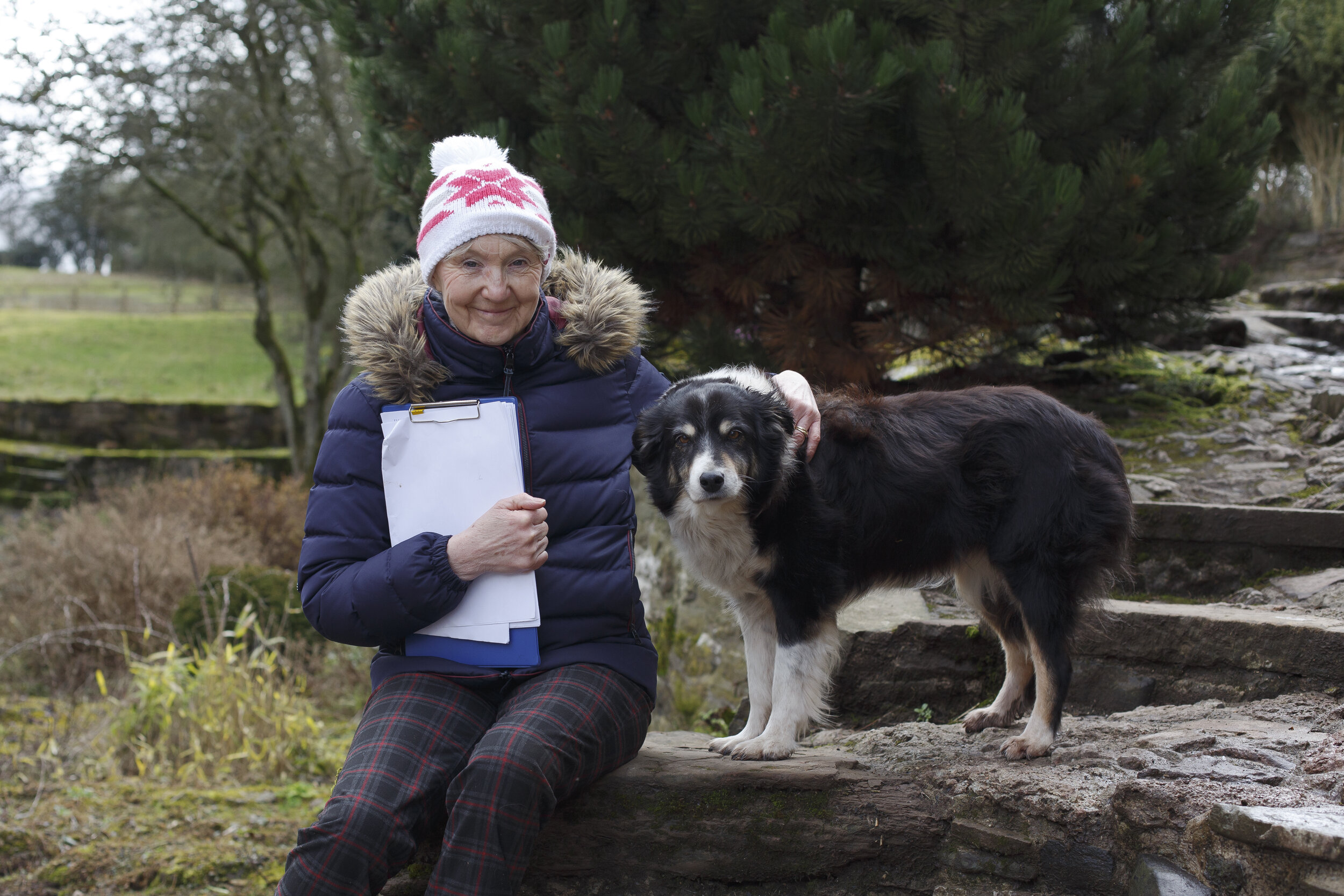
The Unexpected Appearance of the Collie During the Shoot
As the shoot progressed, Sue and Martin’s elderly Collie eventually joined us. The dog’s presence added an unplanned but welcome layer to the portrait session.
Rather than interrupting the flow of the shoot, it enhanced it. The Collie moved slowly through the orchard spaces and around the cottage, naturally integrating into the environment in a way that felt entirely consistent with the rural setting.
These moments often become some of the most memorable in editorial photography—unplanned, authentic interactions that reveal more about the subject’s life than any posed arrangement could.

Reflections on Editorial Photography in Rural England
Assignments like this highlight why rural editorial photography remains so compelling. Working in places like the Shropshire offers a depth of environment that directly influences the visual outcome.
There is a rhythm to rural locations that encourages slower observation and more thoughtful composition. In this case, the combination of historic architecture, working landscape, and lived-in domestic space created a complete narrative framework for the portraits.
The collaboration between subject, environment, and editorial intent came together in a way that felt entirely cohesive.
Returning to Shropshire for Future Photography Assignments
After wrapping the shoot, I left with the sense that this was one of those assignments that stays with you longer than expected—not just because of the location, but because of the process of getting there and the time spent within it.
I was fortunate to return to Shropshire only a few weeks later for a very different type of photographic assignment, which I will explore in a later post.
For now, this editorial portrait session remains a strong example of how environment-led photography can shape both the subject and the story in unexpected ways.