Latest Editorial, Portrait & Commercial Photography Projects
A selection of my most recent commissions and ongoing projects.
The work shown here spans editorial assignments, portrait commissions, documentary projects and commercial photography for organisations and publishers. It reflects current areas of focus and the range of contexts in which I am working.
New projects are added regularly.
The Mirrorless Makeover: Why Pro Photographers are Ditching Their DSLRs
The Mirrorless Makeover: Why Pro Photographers are Ditching Their DSLRs
At the time of writing, there are two main types of camera systems: DSLR (Digital Single-Lens Reflex) and mirrorless. At the time of reading the latter may be a relic of a bygone era, so let's have a look at what happened...

Thomas Sutton
At the time of writing, there are two main types of camera systems: DSLR (Digital Single-Lens Reflex) and mirrorless. At the time of reading the latter may be a relic of a bygone era, so let's have a look at what happened...
Firstly, let's have a whistlestop history of the Single-Lens Reflex (SLR) system.
Single-Lens Reflex (SLR) system
Prior to the development of SLR, all cameras with viewfinders had two optical light paths: one path through the lens to the film, and another path positioned above (TLR or twin-lens reflex) or to the side (rangefinder). Because the viewfinder and the film lens cannot share the same optical path, the viewing lens is aimed to intersect with the film lens at a fixed point somewhere in front of the camera. This is not problematic for pictures taken at a middle or longer distance, but parallax causes framing errors in close-up shots. Moreover, focusing the lens of a fast reflex camera when it is opened to wider apertures (such as in low light or while using low-speed film) is not easy.
The photographic single-lens reflex camera (SLR) was invented in 1861 by Thomas Sutton, a photography author and camera inventor who ran a photography related company together with Louis Désiré Blanquart-Evrard on Jersey. Only a few of his SLRs were made.[1] The first production SLR with a brand name was Calvin Rae Smith's Monocular Duplex (USA, 1884). Other early SLR cameras were constructed, for example, by Louis van Neck (Belgium, 1889), Thomas Rudolphus Dallmeyer (England, 1894) and Max Steckelmann (Germany, 1896), and Graflex of the United States and Konishi in Japan produced SLR cameras as early as 1898 and 1907 respectively. These first SLRs were large format cameras.[2] [3]
The first 35mm prototype SLR was the "Filmanka" developed in 1931 by A. Min in the Soviet Union.[4] In 1933 A.O. Gelgar developed the "GelVeta" also in the USSR, later re-named Спорт ("Sport").[5]

Ihagee Kine Exakta
The first 35mm format SLR in large scale production was the Ihagee Kine Exakta, produced in 1936 in Germany, which was fundamentally a scaled-down Vest-Pocket Exakta. This camera used a waist-level finder.
Most SLR cameras permit upright and laterally correct viewing through use of a roof pentaprism situated in the optical path between the reflex mirror and viewfinder. Light, which comes both horizontally and vertically inverted after passing through the lens, is reflected upwards by the reflex mirror, into the pentaprism where it is reflected several times to correct the inversions caused by the lens, and align the image with the viewfinder. When the shutter is released, the mirror moves out of the light path, and the light shines directly onto the film. The viewfinder of an SLR presents an image that will not differ substantially from what is captured by the film as it presents it as a direct optical view through the main camera lens, rather than showing an image through a separate secondary lens.

The legendary Nikon F and Nikkor F
So, we've now raced through camera development to the point where we have the 35mm film SLR, further refinements of which brought us Through the Lens (TTL) metering and Automatic Exposure. The first autofocus 35 mm SLR was the Pentax ME-F released in 1981.[6]
Up to this point photographic images were captured on film - perhaps the subject for a future article - but advances in semiconductor technology were about to bring about a seismic shift.

Delta-Doped Charged Coupled Devices (CCD) for Ultra-Violet and Visible Detection
A charge-coupled device (CCD) is an integrated circuit containing an array of linked, or coupled, capacitors that can convert photons incident upon them to electron charges. the first time this technology was used in an imaging context was by Gil Amelio, Michael Francis Tompsett and George Smith in April 1970[7]. Fairchild Semiconductors team, led by ex-Bell researcher Gil Amelio, was the first with commercial devices, and by 1974 had a linear 500-element device and a 2D 100 × 100 pixel device. Steven Sasson, an electrical engineer working for Kodak, invented the first digital still camera using a Fairchild 100 × 100 CCD in 1975.[8]
The large quality advantage CCDs enjoyed early on has narrowed over time particularly since the development of the CMOS (Complimentary Metal Oxide Silicon) sensor by Eric Fossum's team at the NASA Jet Propulsion Laboratory in 1993.[9] Since the late 2010s CMOS sensors are the dominant technology, having largely if not completely replaced CCD image sensors.

1981 Sony Mavica Prototype
The first filmless SLR (single lens reflex) camera was publicly demonstrated by Sony in August 1981. The Sony “Mavica” (magnetic still video camera) used a color striped 2/3” format CCD sensor with 280K pixels, along with analogue video signal processing and recording.[10] The Mavica electronic still camera recorded FM modulated analog video signals on a newly developed 2” magnetic floppy disk, dubbed the “Mavipak”. The disk format was later standardized as the “Still Video Floppy”, or “SVF”.
Replacing film with a similar-sized digital sensor was possible, but expensive because larger sensor areas imply a greater probability that a defect will render the sensor non-functional. Such "full frame" sensor digital SLRs (DSLRs) however gained early popularity with professional photographers who could both justify their initial high cost, and retain the use of their investment in expensive 35 mm film lenses. By 2008, full-frame models such the Canon EOS 1Ds and 5D, the Nikon D3 and D700, and the Sony Alpha A850 and Alpha A900, designed and priced for professionals, were available.
Finally, we reach the DSLR era, all the advantages of decades of SLR camera development coupled with decades of research into CCD and later CMOS sensors to provide the perfect image making device. But then something new happened.
Mirrorless
In late 2008, a new type of camera emerged, called a mirrorless interchangeable-lens camera. It is technically a DSLR camera that does not require a reflex mirror, a key component of the former. While a typical DSLR has a mirror that reflects light from the lens up to the optical viewfinder, in a mirrorless camera, there is no optical viewfinder. The image sensor is exposed to light at all times, giving the user a digital preview of the image either on the built-in rear LCD screen or an electronic viewfinder (EVF).[11]
Mirrorless cameras are mechanically simpler than DSLR cameras, and are smaller, lighter, and quieter due to the elimination of the moving mirror. While nearly all mirrorless cameras have a mechanical shutter, many also have an electronic shutter, allowing completely silent operation.[12] The first digital rangefinder camera commercially marketed was the Epson R-D1 (released in 2004), followed by the Leica M8. They were some of the first digital lens-interchangeable cameras without a reflex mirror, but they are not mirrorless cameras because they did not use a digital display system for live preview.
The first mirrorless camera commercially marketed was the Panasonic Lumix DMC-G1, released in Japan in October 2008. It was also the first camera of Micro Four Thirds system, developed exclusively for the mirrorless system.
Until the mid-2010s mirrorless cameras were somewhat challenged to provide an electronic viewfinder with the clarity and low-lag responsiveness of the optical viewfinders used on DSLRs, especially under strong sunlight or when photographing the sky at night.[13]

Fujifilm X-Pro1
The Fujifilm X-Pro1, announced in January 2012, was the first non-rangefinder mirrorless with a built-in optical viewfinder. Its hybrid viewfinder overlaid electronic information, including shifting frame-lines, to compensate for the parallax effect. Its 2016 successor, the X-Pro2, had an updated version of this viewfinder. Canon was the last of the major manufacturer of DSLRs to announce their own mirrorless camera, announcing the Canon EOS M in 2012 with APS-C sensor.
After having debuted at the bottom of the market and having technologically advanced rapidly due to advances in mobile phone camera and video camera manufacturing, mirrorless lens systems created significant interest from camera manufacturers as a possible alternative in high-end camera manufacturing. Mirrorless cameras have fewer moving parts than DSLRs, and are more electronic, which is an advantage to electronics manufacturers (such as Panasonic, Sony and Samsung), as they eyed the market share of dedicated camera manufacturers who had significant advantages in precision mechanical engineering.
On-sensor autofocus is free of the adjustment requirements of the indirect focusing system of the DSLR (which relies on a separate autofocus sensor located below the reflex mirror), and as of 2018 mirrorless cameras could shoot with phase-detect autofocus at up to 20 frames per second using up to 693 focus points—a number far exceeding what was available on any DSLR.[14]
Mirrorless v DSLR: Summary
The rise of mirrorless cameras has disrupted the traditional dominance of DSLR cameras in the professional photography industry.
One of the main advantages of mirrorless cameras is their compact size and weight compared to DSLRs. Mirrorless cameras are typically smaller and lighter than DSLRs, making them more portable and easier to carry around, especially beneficial for professional photographers who often have to travel to different locations and carry multiple cameras and lenses.
A significant technical advantage of mirrorless cameras is their advanced autofocus systems. Mirrorless cameras use on-sensor contrast-detection autofocus (AF) systems, which can quickly and accurately focus on the subject even in low light conditions. In contrast, DSLRs use a phase-detection autofocus system, which can struggle in low light conditions and can require the use of external lighting. The autofocus system of mirrorless cameras is also more versatile, as it can track moving subjects across the frame and can be used for both still photography and video recording.
Mirrorless cameras also offer several features that are not available in DSLRs. For example, mirrorless cameras can shoot silently, which is beneficial for photographers who need to capture images without disrupting the environment, such as while photographing alongside a video shoot. Mirrorless cameras also offer in-body image stabilization (IBIS), which stabilizes the camera sensor to compensate for camera shake and allows for smoother hand-held shooting. This eliminates the need for image stabilization (IS) in lenses, which can be expensive and bulky. When used in combination with IS lenses the effect is multiplied, allowing the possibility of hand holding at remarkably slow shutter speeds.
Mirrorless cameras offer faster burst rates and higher frames per second (fps) than DSLRs. useful for capturing fast-moving subjects such as in sports or wildlife.
In recent years, mirrorless cameras have also made significant advancements in image quality, with many models offering high resolution and dynamic range. This is due to improvements in sensor technology and image processing, which has narrowed the gap between mirrorless and DSLR image quality.
Overall, mirrorless cameras have become the preferred choice for many professional photographers due to their compact size, advanced autofocus system, versatility, and high-performance features. While DSLRs still have some advantages, such as longer battery life and a wider selection of lenses, mirrorless cameras have established themselves as a serious competitor in the professional photography market. As technology continues to advance, it is likely that mirrorless cameras will continue to push the boundaries of what is possible in photography.
References
[1] Coe, Brian (1978). Johnston, Turlough (ed.). Cameras. USA: Crown Publishers, Inc. p. 133. ISBN 0-517-53381-2.
[2] Rudolf Kingslake: The Photographic Manufacturing Companies of Rochester, New York, p. 21
[3] Konishi: Sakura Reflex Prano; source The Japanese Historical Camera, p. 5
[4] Proletarskoe Foto, No. 3, 1933
[5] A.O. Gelgar's Sport, Wikipedia entry
[6] Pentax Imaging Company. "History of Innovations 1980–1989". Pentax history of innovations. Archived from the original on 2007-09-28. Retrieved 2006-10-22.
[7] Gilbert Frank Amelio; Michael Francis Tompsett; George E. Smith (April 1970). "Experimental Verification of the Charge Coupled Device Concept". Bell Syst. Tech. J. 49 (4): 593–600. doi:10.1002/j.1538-7305.1970.tb01791.x.
[8] Dobbin, Ben (8 September 2005). "Kodak engineer had revolutionary idea: the first digital camera". Seattle Post-Intelligencer. Archived from the original on 25 January 2012. Retrieved 2011-11-15.
[9] Fossum, Eric R.; Hondongwa, D. B. (2014). "A Review of the Pinned Photodiode for CCD and CMOS Image Sensors". IEEE Journal of the Electron Devices Society. 2 (3): 33–43. doi:10.1109/JEDS.2014.2306412.
[10] Kihara, N.; Nakamura, K.; Saito, E.; Kambara, M. (June 1982). "The Electrical Still Camera a New Concept in Photography". IEEE Transactions on Consumer Electronics. CE-28 (3): 325–331. doi:10.1109/TCE.1982.353928. ISSN 1558-4127.
[11] Gannon Burgnett. "What's a mirrorless camera and what makes it different from a DSLR?". Digital Trends. Retrieved February 16, 2019.
[12] Corporation, Sony. "Help Guide | Silent Shooting". helpguide.sony.net. Retrieved August 11, 2018.
[13] "Sony's new mirrorless camera EVF is 60 percent sharper". Engadget. Retrieved August 11, 2018.
[14] "Close up | Sony a9 focus modes | Fixation". www.fixationuk.com. Retrieved August 11, 2018.
The Canon 5D: A post mortem
As a professional photographer who used most models of the Canon 5D series of DSLRs, and who recently made the switch to mirrorless with the Canon R5, I thought it would be useful to review the 5D line, its origins and how it developed before its recent replacement. Each iteration of the 5D brought new and exciting features that improved image quality and technical capabilities, making it a popular choice among photographers and filmmakers alike. In this article, I will delve into the technical and image quality differences of the Canon 5D series, from the original Mark I to the most recent Mark IV.
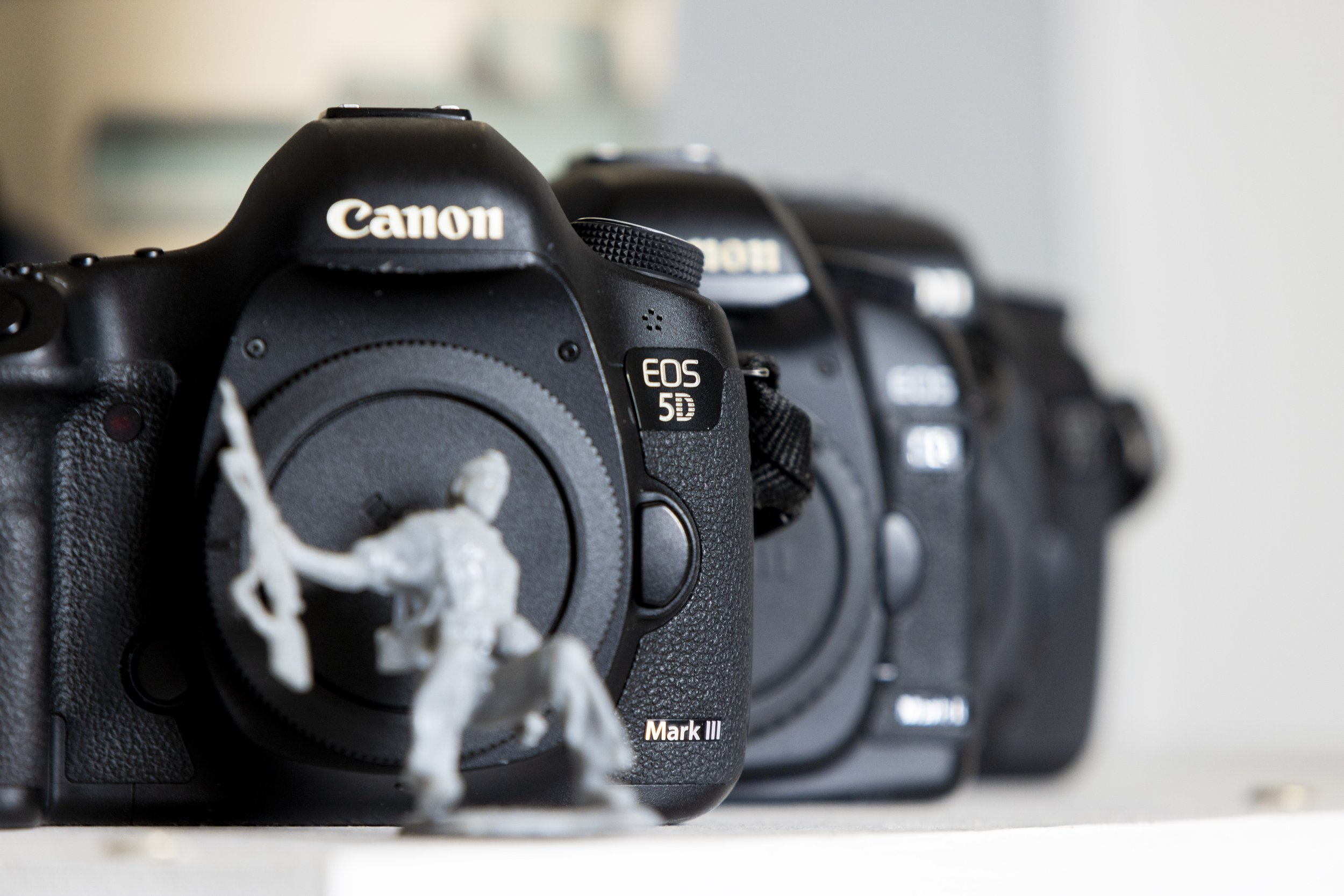
As a professional photographer who used most models of the Canon 5D series of DSLRs, and who recently made the switch to mirrorless with the Canon R5, I thought it would be useful to review the 5D line, its origins and how it developed before its recent replacement. Each iteration of the 5D brought new and exciting features that improved image quality and technical capabilities, making it a popular choice among photographers and filmmakers alike. In this article, I will delve into the technical and image quality differences of the Canon 5D series, from the original Mark I to the most recent Mark IV.
Canon 5D Mark I
The Canon 5D Mark I was released in 2005 and was a game-changer for photographers. It was the first full-frame camera that was affordable and widely available, which opened up new possibilities for image quality and low-light performance. The camera had a 12.8-megapixel CMOS sensor, a 9-point autofocus system, and a maximum ISO of 1600.
Compared to today's standards, the Canon 5D Mark I may seem limited in its capabilities. However, it was a ground breaking camera that introduced many photographers to the world of full-frame digital photography. One of the main advantages of the camera was its 35mm equivalent sensor, which allowed for a shallower depth of field and better low-light performance.
The Canon 5D Mark I was compatible with the massive range of Canon EF lenses including the L-series so beloved by working photographers for their image quality, sharpness and robustness. This made it an attractive option for photographers who already owned Canon lenses that they were using with 35mm film bodies and wanted to upgrade to a full-frame digital camera without breaking the bank. At the time, I was shooting 35mm film with a Canon EOS30, an interesting camera in itself with its Eye Control autofocus system which, after you'd calibrated it by pointedly looking around the viewfinder, attempted to track your eye movements and focus on the things in the frame you were looking at, with some fairly mixed results. Eye Control made it down to the EOS 30 from the EOS 3 and EOS 5 but was later dropped for 30 years before a glorious and perhaps somewhat unexpected return in the latest R3 models
The 5D Mk1 slotted into my camera bag as a direct replacement for the EOS 30. The most noticeable change this switch brought about as a working professional was an almost immediate end to daily visits to the processing lab and complete removal of film and processing costs from the business. What it brought in its stead was long hours of digital editing, a process that now takes up 30% of my working time.
While the Canon 5D Mark I was a remarkable camera for its time, it did have limitations in terms of autofocus performance and image quality compared to later models in the series.
Canon 5D Mark I:
12.8-megapixel CMOS sensor
ISO range of 100-1600 (expandable to 50-3200)
9-point autofocus system
3 frames per second continuous shooting
2.5-inch LCD screen

Canon 5D Mark II
The Canon 5D Mark II was released in 2008 and was a significant upgrade from the Mark I. The camera featured a 21.1-megapixel CMOS sensor, a 9-point autofocus system, and a maximum ISO of 25600. One of the most significant improvements in the Canon 5D Mark II was its video capabilities, with the ability to shoot 1080p video at 30fps.
The addition of video capabilities in the Canon 5D Mark II was a game-changer for filmmakers. It allowed them to shoot high-quality video with a relatively affordable camera, which opened up new possibilities for filmmaking. The camera also featured improved dynamic range and low-light performance, making it even more versatile for photographers.
Another significant improvement in the Canon 5D Mark II was its Live View mode, which allowed photographers to preview their shots on the camera's LCD screen before taking the picture. This was a significant improvement over the Mark I, which did not have a Live View mode.
The 5D II was an improvement for still photographers but it was really a massive leap for Canon and launched the careers of many film makers who could now get dreamy, short focus cinematic images without the need for cinema video cameras at ten times the price. The 5D II marked the beginning of a phase, only just coming to a close, in which you would turn up for a job and be using the same equipment as the videographer. I knew film making groups , like Manchester’s ‘Bokeh, Yeah’ that were set up as a result of the launch of this camera and its contemporaries. The mark 2’s use of quality optics and 35mm equivalent sensors brought cinematographic images to the masses when video cameras at the time were still using small sensors with their inevitable deep, and deeply non-cinematic, front to back sharpness. Since the mk2, contemporary pro digital stills cameras are with few exceptions exemplary video shooters, albeit with some designed in limitations to increase the attractiveness of more specialised equipment.
The Canon 5D Mark II did however have limitations in terms of autofocus performance, which was a significant issue for photographers who needed fast and accurate autofocus. Here, you were forced into 1DX territory with that camera body's associated financial and physical weight.
Canon 5D Mark II
21.1-megapixel CMOS sensor
ISO range of 100-6400 (expandable to 50-25600)
9-point autofocus system
3.9 frames per second continuous shooting
Full HD video recording at 1080p

Canon 5D Mark III
The Canon 5D Mark III was released in 2012 and was a significant improvement from the Mark II. The camera featured a 22.3-megapixel CMOS sensor, a 61-point autofocus system, and a maximum ISO of 25600 (expandable to 102400). The autofocus system in the Canon 5D Mark III was a significant improvement over the Mark II, with faster and more accurate autofocus performance.
Another significant improvement in the Canon 5D Mark III was its improved dynamic range and noise performance. The camera's sensor and improved dynamic range meant that images were even sharper, more detailed, and had even more accurate colours. The camera performed even better in low-light conditions, with the expanded ISO range allowing for even better results in dark environments.
The Mark III also featured an increased frame rate. The camera could shoot up to 6 frames per second, which was a significant improvement over the 3.9 frames per second in the Mark II. This made it a more attractive option for photographers who needed a faster frame rate, such as sports or wildlife photographers.
The Canon 5D Mark III also featured improved video capabilities, with the ability to shoot 1080p video at up to 60fps. The camera also had a headphone jack and improved audio controls, making it a more versatile option for filmmakers.
Overall, the Canon 5D Mark III was a significant improvement over the Mark II in terms of autofocus performance, image quality, and technical capabilities.
This camera was so good that I didn't upgrade to the Mark IV. Autofocus was much quicker even with the heavy glass elements in L-series lenses, image quality was improved but, in reality, was only a marginal gain over the mk II. Increased dynamic range and high ISO performance are the holy grails for me, the mk III provided another incremental improvement in dynamic range but ISO performance, while expanded, may have been useful for wildlife and sports shooters looking for fast shutter speeds in bright conditions, but in the low light conditions that I'm often shooting in, gain noise at over ISO 1600 was excessive. The struggle, sadly to this day, continues!
In its dotage, my mark II developed a hotshoe problem that meant that auto metering of flash output was impossible. Faced with the expense and more importantly the cost in time of a repair, I upgraded to the mark 3. The mk2 subsequently become my travel camera and has been around a bit, often in less than salubrious surroundings and less than luxurious luggage hence its scuffed paint and filthy strap. God knows the shutter count, to the moon and back, but it keeps on rolling…

Canon 5D Mark III
22.3-megapixel CMOS sensor
ISO range of 100-25600 (expandable to 50-102400)
61-point autofocus system
6 frames per second continuous shooting
Full HD video recording at 1080p at up to 60fps
Canon 5D Mark IV
The Canon 5D Mark IV was released in 2016 and featured a 30.4-megapixel CMOS sensor, a 61-point autofocus system, and a maximum ISO of 32000 (expandable to 102400). The autofocus system in the Mark IV was an improvement over the Mark III, with even faster and more accurate autofocus performance.
One of the most significant improvements in the Canon 5D Mark IV was its dual-pixel autofocus system, which was first introduced in the Canon EOS 70D. The dual-pixel autofocus system allowed for faster and more accurate autofocus performance in Live View mode, making it easier to capture sharp images in challenging situations.
Another significant improvement in the Canon 5D Mark IV was its improved dynamic range and noise performance. The camera's sensor and improved dynamic range meant that images were even sharper, more detailed, and had even more accurate colours. The camera also performed exceptionally well in low-light conditions, with the expanded ISO range allowing for even better results in dark environments.
The Canon 5D Mark IV also featured improved video capabilities, with the ability to shoot 4K video at up to 30fps. The camera also had improved audio controls, making it a more versatile option for filmmakers.
One of the most significant improvements in the Canon 5D Mark IV was its built-in WiFi and GPS capabilities. The WiFi feature allowed photographers to quickly and easily transfer images to their computer or smartphone, while the GPS feature allowed them to geotag their images with location data.
Overall, the Canon 5D Mark IV was a significant improvement over the Mark III in terms of autofocus performance, image quality, and technical capabilities. The dual-pixel autofocus system and built-in WiFi and GPS features made it a more versatile option for photographers and filmmakers.
Canon 5D Mark IV
30.4-megapixel CMOS sensor
ISO range of 100-32000 (expandable to 50-102400)
61-point autofocus system with dual-pixel autofocus
7 frames per second continuous shooting
4K video recording at up to 30fps
Conclusion
The Canon 5D series has been a popular choice among professional photographers and filmmakers since the release of the original 5D in 2005. Each model in the series has seen significant improvements in image quality and technical capabilities, it's been my go-to series offering pro level build quality and weather sealing, pro level imaging and a price point that while not cheap, is less mortgage worrying than the 1DX series. If you didn't need the lightning-fast burst speeds of a sports shooter and unlike the newspaper shooters you were buying your own equipment, it was a no brainer and it was bomb proof and totally reliable.
In 20 years I never had a body fail and I’ve dropped them and had them filled with rainwater so you could see it behind the screens. I dried them out in an oven - not recommended - and they trudged on for years like nothing had happened.
Epilogue: The Canon 5D Mark V
Speculation about the Mk V update gave way to scepticism after the 2018 launch of the Canon EOS R mirrorless camera and Canon confirmed that the Mk IV would be the end of the line for its popular DSLR range in June 2020 leaving the 1D X Mark III as its final SLR.
While the reasons behind Canon's decision not to produce a 5D Mark V are not entirely clear, it is likely a combination of factors that contributed to the decision. The rise of mirrorless cameras, shifting customer preferences, high development costs, and the popularity and longevity of the existing 5D cameras are all factors that may have influenced Canon's decision. Ultimately, Canon's decision to focus on developing new mirrorless cameras and expanding its camera line-up with new product lines such as the EOS R series may also have played a significant role.
So, professionals were left with a simple step over to the EOS R mirrorless system, right? Not quite, The EOS R is based, as the name suggests, around a new R mount, necessitating replacing the previous EF lenses with newer RF lenses. EF lenses can be used on R mount cameras with an adapter, but if you go all in with the new - and excellent - range of RF lens then you’re not bolting them to your old EF bodies, adapter or not.
Canon had been rolling out R mount glass for a while and the reviews of these lenses were stellar so, notwithstanding the lens compatibility issues, we could expect a pretty painless transition to the EOS R, that was until the reviews started to come in.
While the new glass was of high quality, there was limited lens selection at launch; when the Canon EOS R was first released, it only had four native RF lenses available, which was a relatively limited selection compared to Canon's vast line-up of EF and EF-S lenses. Pro photographers who had the cash to completely upgrade to the new system would be forced to adapt their EF glass at first.
The EOS R only had a single SD card slot, which was a concern for professional photographers who require a backup storage option especially when they’d become accustomed to it in the 5D mk3 and mk4.
No in-body image stabilization: The EOS R did not have in-body image stabilization, which was a drawback for photographers who rely on this feature for shooting in low light or when using longer focal length lenses.
Limited battery life: The EOS R has a relatively short battery life compared to other mirrorless cameras on the market, which may be a concern for photographers who shoot for extended periods of time.
Crop factor when using EF lenses: While the EOS R can use EF lenses with an adapter, these lenses will have a crop factor of 1.6x, which may be a drawback for photographers who require a full-frame field of view.
So, if you were a serious photographer who fancied using the excellent new lenses, didn't need a massive arsenal of focal length options, liked to shoot video and could use a little less size and weight, the EOS R was ticking a lot of boxes.
If you were a professional, shooting on the now defunct 5D and looking for an upgrade or replacement, the landscape looked a bit bare until some new EOS R bodies were announced. These came in the form of the R5 and R6, but we'll get into those in a future article.